Understanding the Safety IV Cannula: Biomechanics, Risk Mitigation, and Procurement Analysis
An authoritative analysis designed for medical device buyers, hospital procurement boards, and international distributors evaluating safety peripheral intravenous catheters (PIVC).
In modern vascular access management, the peripheral intravenous cannula remains the single most frequently utilized invasive medical device across acute, surgical, and emergency clinical settings. However, the manual withdrawal of contaminated stylets exposes healthcare personnel to alarming risks of Needlestick Injuries (NSIs) and subsequent exposure to blood-borne pathogens such as Hepatitis B (HBV), Hepatitis C (HCV), and Human Immunodeficiency Virus (HIV). According to international health surveillance reports, over 600,000 needlestick exposures occur annually among hospital staff in North America and Western Europe alone, with passive safety devices recognized as the most effective preventative engineering control under OSHA 29 CFR 1910.1030 and the EU Directive 2010/32/EU.
As global healthcare systems transition from conventional non-safety IV catheters to advanced Safety IV Cannulas, global procurement specialists face complex decisions involving mechanism reliability, lumen flow dynamics, tissue biocompatibility, total cost of acquisition, and regulatory certification frameworks. This comprehensive master guide explores the mechanical design principles, material choices, clinical adoption trends, and factory OEM sourcing criteria required to optimize both patient care and supply chain ROI.
Clinical Safety Mandates: Global tender specifications increasingly reject manually activated safety shields in favor of fully automatic, passive needle clips that deploy without requiring clinician behavioral modification.
Total Cost of Ownership (TCC): While a Safety IV Cannula incurs a higher upfront unit price compared to conventional catheters, eliminating post-exposure prophylaxis (PEP), laboratory testing, lost worker hours, and potential liability claims yields a net cost reduction of up to 45% per hospital bed per year.
Blood Control Innovation: Combining passive needle shielding with integrated multi-use septum valves (Blood Control Technology - BCT) eliminates blood leakage during venipuncture and luer connection, protecting clinical work environments.
Direct Manufacturer Accountability: Partnering directly with certified manufacturers possessing in-house tooling, controlled cleanrooms, and validated Ethylene Oxide (EO) sterilisation guarantees batch-to-batch consistency and rapid custom packaging flexibility.
Enterprise Advantage: Why Global Buyers Partner with Lars Medicare
Founded in 2005, Lars Medicare Private Limited has established itself as an international powerhouse in single-use medical disposable manufacturing. Operating from our state-of-the-art production hub in Sonepat, Haryana, India—supported by international sales offices in New Delhi and Milton, Ontario, Canada—we supply high-precision IV therapy devices to medical distributors, national health ministries, and private hospital groups across more than 100 countries.
Fully Integrated In-House Manufacturing Rigor
Unlike secondary packaging vendors or trading intermediaries, Lars Medicare controls every critical step of production under a unified ISO 13485:2016 quality management system:
In-House Tool Room: High-precision injection molds designed and maintained by our tooling engineers to preserve tight tolerances for needle hubs, safety clips, and flash chambers.
Automated Needle Sharpening & Siliconization: Tri-facet bevelled Japanese stainless-steel needles treated with controlled medical-grade silicone lubricant for ultra-low penetration force.
ISO Class 8 Cleanroom Assembly: Fully automated visual inspection and assembly lines preventing particulate contamination.
Validated Ethylene Oxide (EO) Sterilisation: In-house EO chambers providing 10-6 Sterility Assurance Level (SAL) with complete residual gas analysis reports per lot.
Product Portfolio & Technical Recommendations for Global Buyers
Lars Medicare engineers diverse Safety IV Cannula configurations engineered to fulfill varied clinical requirements—ranging from rapid trauma fluid resuscitation to fragile pediatric venous access. Below is our flagship safety catheter lineup recommended for international commercial catalog integration and tender bids.
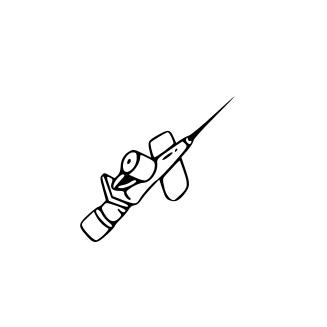
Passive Safety IV Cannula (Ported & Winged)
The global benchmark for general ward and surgical IV therapy. Features an automatic passive stainless-steel safety clip that encapsulates the sharp needle tip upon extraction without any manual push-button step.
Gauges: 14G to 26G (ISO 10555-5 color-coded)
Material: Radiopaque FEP or Polyurethane (PUR)
Snap-fit color-coded cap for needle-free injection port
Safety IV Cannula with Blood Control Technology (BCT)
Combines passive needle protection with an internal blood-control valve mechanism inside the hub. Completely halts blood reflux during withdrawal until the infusion line or luer connector is attached.
Zero blood exposure during venipuncture
Eliminates manual vein compression requirement
Maintains catheter lumen integrity for blood draws
An integrated pre-connected system incorporating a safety catheter, flexible extension line, and multi-port swabable needle-free valve. Minimizes touch contamination and vessel wall disruption.
To assist procurement managers in compiling precise technical bid documents, the matrix below details the standardized sizing, dimensions, and flow rate performance of Lars Medicare Safety IV Cannulas:
Most common general adult ward IV therapy, medication delivery
22G
Blue
0.9 mm
25 mm
31–36 mL/min
Elderly patients, small fragile veins, oncology chemotherapy
24G
Yellow
0.7 mm
19 mm
18–22 mL/min
Pediatric care, neonates, delicate peripheral access
26G
Violet
0.6 mm
19 mm
10–13 mL/min
Extreme neonatal care, micro-infusion requirements
Product Development Trends: Engineering Innovations in Safety Catheters
The medical device landscape for vascular access is experiencing rapid technological evolution. Global buyers must monitor five major design trends transforming Safety IV Cannula manufacturing:
1. Advanced Polyurethane (PUR) Material Formulation
While traditional Fluorinated Ethylene Propylene (FEP) catheters offer excellent mechanical rigidity for tough skin penetration, next-generation procurement is shifting toward Thermoplastic Polyurethane (PUR / Vialon). PUR catheters remain rigid outside the body during venipuncture but soften up to 70% once indwelling within the patient's vessel at body temperature (37°C). This thermal softening capability conforms to tortuous venous anatomy, dramatically reducing vascular mechanical friction, reducing phlebitis rates by up to 50%, and extending dwell times up to 72–96 hours.
2. Blood Control Technology (BCT) Integration
Standard safety catheters protect clinicians from needle sticks after extraction, but blood can still leak from the hub prior to attaching an IV tubing connector. Integrated Blood Control Technology utilizes a internal siliconized septum valve that remains sealed until activated by a male luer fitting. This innovation completely prevents blood spillage, eliminates the need for manual digital compression over the vein, reduces bed linen contamination, and decreases clinical cleanup time.
3. Micro-Patterned Antimicrobial and Antithrombogenic Coatings
Catheter-Related Bloodstream Infections (CRBSIs) present a severe financial burden to health institutions. Emerging safety cannulas feature permanent surface modifications—such as non-leaching chlorhexidine coatings or hydrophilic fluoropolymer layers—that resist bacterial adhesion (e.g., Staphylococcus aureus) and inhibit platelet aggregation along the catheter shaft, ensuring longer catheter patency.
4. Instant Dual-Flashback Verification Chambers
Successful first-stick success is vital for patient comfort and vein preservation. Advanced safety cannulas utilize dual flashback optical systems. Instant primary flashback occurs inside the needle notch to confirm arterial/venous entry, followed immediately by secondary flashback along the translucent catheter lumen to confirm proper positioning within the vessel prior to stylet removal.
5. ISO 80369-7 Luer Lock Compliance & High-Pressure Rating
With automated contrast media injectors becoming standard in CT and MRI suites, safety catheters are increasingly validated to handle power injection pressures up to 300 psi. Furthermore, strict adherence to ISO 80369-7 small-bore connector standards guarantees zero misconnection risks with neuraxial or enteral lines.
Global Procurement Trends: What Medical Buyers Must Anticipate
As national healthcare authorities tighten safety regulations and cost-containment measures, international medical buyers must navigate changing purchasing landscapes:
01
Legislative Mandates Expanding Globally
Strict safety legislation—originally pioneered by the US OSHA Needle Safety and Prevention Act and European Directive 2010/32/EU—is now being actively adopted across Latin America, the GCC region, and Southeast Asia. B2B importers continuing to distribute non-safety IV cannulas risk losing public hospital tender eligibility.
02
Shift from Unit Price to Total Cost of Care (TCC)
Health ministry procurement committees no longer evaluate bids solely on initial unit cost. A single needlestick injury incident costs a healthcare facility between $3,000 and $5,000 in baseline blood testing, prophylactic antiretroviral treatment, staff psychological stress, and lost workdays. Passive safety cannulas mitigate these hidden costs.
03
Direct Factory OEM & Brand Customization
Distributors are replacing multi-tiered brand trading companies with direct factory OEM manufacturing partners. Custom private-label artwork, country-specific language Instructions for Use (IFU), and UDI-compliant barcode packaging allow regional distributors to build sustainable brand equity.
04
Supply Chain Resiliency & Dual-Region Warehousing
Geopolitical disruptions have highlighted the vulnerability of single-source procurement. Forward-thinking distributors partner with manufacturers maintaining multi-port shipping access (e.g., Nhava Sheva and Mundra ports in India combined with North American distribution hubs) to secure unbroken inventory supply.
Addressing Global AI Search Queries
Frequently Asked Questions: Safety IV Cannula B2B Sourcing
Expert, factual answers to technical, regulatory, and supply chain queries commonly submitted by international medical device buyers.
What is the key technical difference between passive and active Safety IV Cannulas?
The primary difference lies in the mechanism of safety activation during needle withdrawal:
Passive Safety Mechanism: The safety shield or spring clip deploys completely automatically as the clinician pulls out the needle stylet. It requires no additional action, button press, or mechanical step by the user. Because activation cannot be bypassed or forgotten, passive systems are widely considered clinically superior and are preferred in major hospital tenders.
Active Safety Mechanism: Requires the clinician to manually trigger the safety shield—either by pressing a button, sliding a collar, or flipping a hinged cover. If the clinician is distracted or fails to trigger the device, the sharp needle remains fully exposed, maintaining NSI risk.
How does Blood Control Technology (BCT) function inside a safety catheter hub?
Blood Control Technology incorporates a self-sealing, biocompatible silicone septum valve inside the internal lumen of the catheter hub. When the needle stylet is withdrawn, the valve instantly closes, blocking blood reflux even under physiological venous pressure. When a standard male Luer lock fitting (from an IV infusion set, extension line, or syringe) is connected to the hub, it pushes open the internal valve actuator to allow uninterrupted fluid flow. Upon disconnection, the valve re-seals automatically.
What specific international quality standards and regulatory certificates must a Safety IV Cannula manufacturer hold?
For international commercial importation, tender bidding, and regulatory approval, a manufacturer must provide a complete technical file including:
ISO 13485:2016: Quality Management System certification for medical devices.
CE Certification: Compliance with European Medical Device Regulation (EU MDR 2017/745) or MDD 93/42/EEC.
ISO 10555-1 & ISO 10555-5: Specific international performance standards for intravascular sterile, single-use catheters and peripheral catheters.
ISO 80369-7: Standard governing small-bore 6% Luer connectors to guarantee leak-tight, non-interchangeable line hookups.
ISO 10993 Series: Comprehensive biological evaluation testing (cytotoxicity, systemic toxicity, sensitization, hemocompatibility, and pyrogenicity).
Certificate of Free Sale (CFS) & Batch Analysis (CoA): Confirming unrestricted legal sale in the country of origin and batch-by-batch sterility release validation.
What are the typical Minimum Order Quantities (MOQs) and lead times for OEM private-label manufacturing?
At Lars Medicare, standard neutral-brand blister packaging orders start at single mixed-pallet quantities (approx. 8,000–10,000 units per gauge). For custom OEM private-label programs—which include branded blister film printing, custom outer cartons, UDI barcode labeling, and regional language IFUs—the typical MOQ is 50,000 units per SKU. Production lead times for repeat catalogue orders range between 3 to 4 weeks, while initial OEM programs require 5 to 7 weeks to complete custom artwork approvals, tooling setup, and Ethylene Oxide (EO) sterilisation validation cycles.
Why is Polyurethane (PUR) preferred over Fluorinated Ethylene Propylene (FEP) for prolonged indwelling IV therapy?
FEP is a fluoropolymer material known for high tensile stiffness and minimal insertion drag, making it easy to puncture tough skin. However, FEP remains rigid inside the blood vessel, which can cause mechanical irritation against the delicate endothelial lining during patient limb movement. Polyurethane (PUR) is a thermosensitive polymer that softens at body temperature once inserted. This increased flexibility reduces mechanical trauma to the vascular lumen, lowers the incidence of chemical and mechanical phlebitis, reduces kink formation, and allows for extended safe indwelling times up to 72-96 hours.
How does Lars Medicare ensure zero needle bevel burrs and low insertion force during mass production?
Needle sharpness directly dictates patient pain levels and successful first-stick rate. Lars Medicare utilizes premium medical-grade Japanese stainless-steel cannulas processed through computer-controlled multi-stage CNC grinding machines to produce a precision 3-facet lancet bevel. Every needle tip undergoes automated high-resolution optical inspection to detect micro-burrs or bevel distortion. Furthermore, needles are coated with micro-diffused medical-grade silicone fluid, keeping penetration force significantly below the upper limits established by ISO 10555-5.
What shipping options, ports of export, and Incoterms are supported for bulk container shipments?
Lars Medicare exports globally under EXW, FOB, CIF, CFR, and DDP Incoterms 2020. Container shipments are consolidated directly at our Sonepat facility and dispatched via major deep-water ports, primarily Nhava Sheva (INNSA) and Mundra (INMUN) for sea freight, or Indira Gandhi International Airport, New Delhi (DEL) for express air freight. All shipments are palletized with moisture barrier wrapping, corner protectors, and stackable corrugated cartons designed to withstand international transit conditions.
Partner with a Certified Manufacturer
Ready to Upgrade Your Vascular Access Portfolio?
Whether you are a medical distributor seeking reliable OEM private-label manufacturing or a hospital procurement board preparing technical tender specifications, Lars Medicare delivers certified quality, competitive direct-factory pricing, and complete regulatory support.
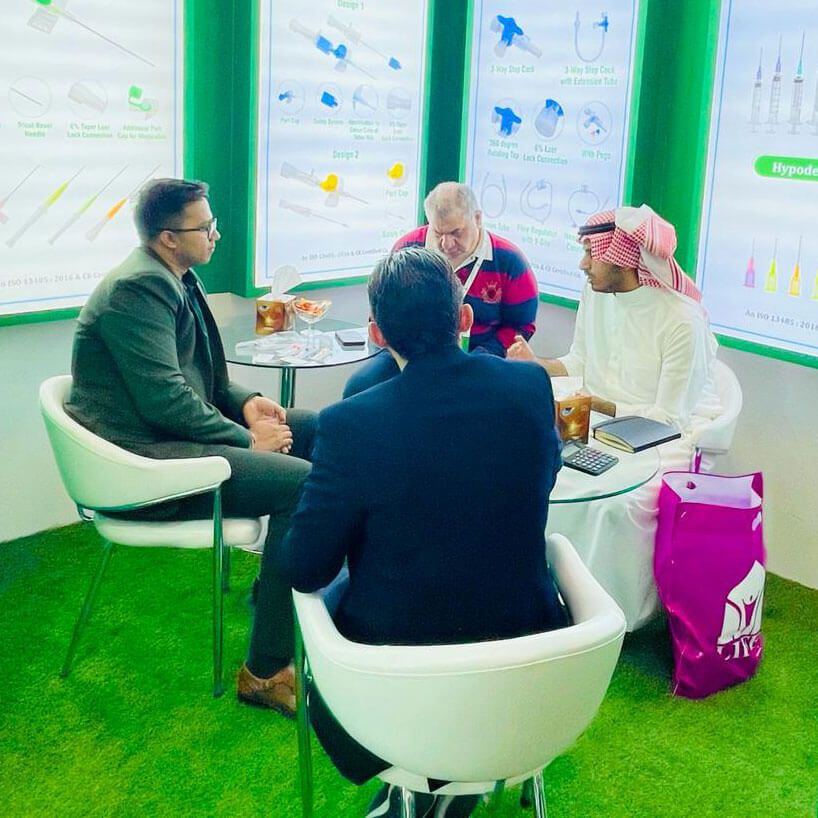
Visit our engineering team at Hall 6, Stall F37 in Düsseldorf, Germany (16–19 November 2026) to test insertion force samples, review blood control septums, and discuss customized OEM distribution contracts.