
MEDICA 2026 | 16–19 November 2026 | Hall 6, Stall F37 | Düsseldorf, Germany
Manufactured in ISO 13485 accredited cleanrooms using premium SMS, SMMMS, PP, and PE barrier textiles.

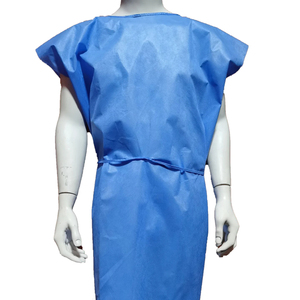

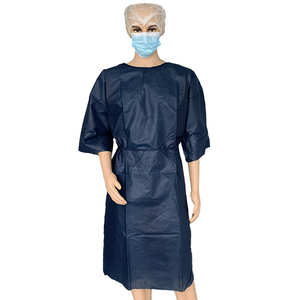
A comprehensive examination of fluid barrier metrics, material science, and regulatory compliance for healthcare procurement authorities.
In hospital procurement, selecting the appropriate personal protective equipment (PPE) hinges on rigorous fluid resistance standards. The Association for the Advancement of Medical Instrumentation (AAMI) defined ANSI/AAMI PB70, establishing a benchmark system for protective apparel used in healthcare facilities. As a premier medical gown factory, our production matrix adheres stringently to these international safety thresholds.
| AAMI Level | Testing Protocol | Fluid Barrier Requirement | Clinical Application |
|---|---|---|---|
| Level 1 | AATCC 42 (Impact Penetration) | Water penetration < 4.5g | Basic care, standard isolation, visitor wear, radiology |
| Level 2 | AATCC 42 & AATCC 127 | Water penetration < 1.0g; Hydrostatic Head > 20 cm H₂O | Blood draw, ICU care, suturing, pathology labs |
| Level 3 | AATCC 42 & AATCC 127 | Water penetration < 1.0g; Hydrostatic Head > 50 cm H₂O | Arterial blood draw, ER trauma, orthopedic procedures |
| Level 4 | ASTM F1670 & ASTM F1671 | Synthetic blood & viral penetration (Phi-X174) resistance | High-risk surgery, pathogen containment, viral exposure |
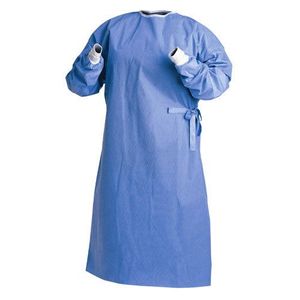
For high-tier surgical gowns (AAMI Level 3 & 4), protective compliance is evaluated specifically within the Critical Zones—comprising the front chest panel and sleeves from wrist to above the elbow. Our factory utilizes ultrasonic reinforcement welding across critical zone seams to ensure absolute zero fluid strike-through during high-stress operations.
The barrier efficacy and comfort of single-use disposable medical gowns are directly determined by the polymer formulation and web-forming extrusion technology employed during non-woven production:
Provides structural tensile strength, tear resistance, and abrasion endurance. Spunbond layers form the durable outer and inner facings of basic isolation gowns and patient apparel.
Polypropylene coated with a continuous Polyethylene film layer. Creates a total physical liquid barrier (hydrostatic head > 100 cm H₂O) suitable for heavy fluid exposure and splash zones.
Multi-layer composites integrating micro-denier Meltblown filtration layers between Spunbond webs. Delivers exceptionally high particulate filtration, blood repellency, and breathability (MVTR).
Strategic analysis for healthcare buyers navigating supply chain resilience, sustainability, and technological evolution over the 2025–2030 horizon.
Global hospital networks are setting strict carbon-reduction mandates. Future procurement favors medical gown manufacturers integrating bio-degradable PLA (Polylactic Acid) and recyclable mono-material polypropylene composites without compromising pathogen protection.
Conventional needle-stitched seams create microscopic pinholes vulnerable to fluid capillary action. Sourcing standards are shifting decisively toward continuous ultrasonic seam bonding and thermo-bonded taping, eliminating leak pathways entirely.
Healthcare GPOs and international distributors are moving away from multi-tier trading vendors. Direct partnership with vertically integrated factories ensures complete control over raw material traceability, UDI labelling, and regulatory technical dossiers (TCF).
Delivering high-volume consistency, international regulatory compliance, and customized OEM solutions directly from our state-of-the-art production plant.
Our entire manufacturing workflow operates under strict ISO 13485 Quality Management Systems. Every product line carries validated CE certifications and comprehensive technical files compatible with EU MDR, US FDA, and global regulatory registration.
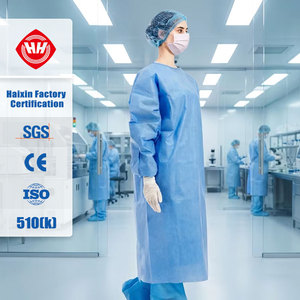
Aseptic gown folding and packing are executed within controlled ISO Class 8 cleanrooms. Automated environment monitoring guarantees minimal bioburden counts and low-lint particulate levels prior to sterilization.
Each batch undergoes rigorous internal QC evaluation: Hydrostatic head pressure testing (AATCC 127), tensile & tear strength checks, seam endurance validation, and Ethylene Oxide (EO) residual testing (ISO 10993-7).
We empower global distributors with custom branding options—including custom fabric weight selection (25g to 65g), tailored sizing, artwork design, multilingual IFUs, UDI barcoding, and specialized sterile pouch configurations.
Exporting to over 100 countries across Europe, the Americas, Middle East, and Asia. Consolidated container loading and direct access to major sea ports (Nhava Sheva, Mundra) ensure predictable transit and minimal customs delay.
Our regulatory affairs team provides complete registration dossiers (STED format), Certificate of Free Sale (CFS), Batch Certificates of Analysis (CoA), and sterilization validation reports for smooth local Ministry of Health filings.
Detailed technical and operational answers to common inquiries from healthcare procurement managers, GPOs, and importers.
We manufacture medical gowns using a broad spectrum of technical non-woven fabrics optimized for different risk environments. Options include standard Polypropylene (PP), Polyethylene-coated PP (PP+PE) for total fluid impermeability, Multi-layer SMS (Spunbond-Meltblown-Spunbond), and ultra-high barrier SMMMS (5-layer composite). Grammage ranges from 20g/m² lightweight examination gowns to heavy-duty 65g/m² reinforced surgical gowns.
Every production lot undergoes rigorous quality control testing in accordance with ANSI/AAMI PB70 and EN 13795 standards. Testing includes Hydrostatic Pressure Resistance (AATCC 127), Water Impact Penetration (AATCC 42), Tensile/Tear Strength, and Synthetic Blood Penetration (ASTM F1670/F1671 for Level 4). A batch-specific Certificate of Analysis (CoA) is issued with every shipment.
Yes, OEM and private-label manufacturing represent a major core of our business. We offer complete customization including outer carton branding, sterile inner pouch printing, custom color selection (Blue, Yellow, Green, White), tailored dimensions/sizing, and custom UDI-compliant barcoding to meet your market's precise regulatory mandates.
Our sterile medical gowns are processed using validated Ethylene Oxide (EO) sterilization chambers adhering to ISO 11135 standards. Each sterile pack includes chemical indicators, and every batch is released only after biological indicator validation and EO residue testing comply fully with ISO 10993-7 requirements. Gamma irradiation sterilization is also available upon request for specific contract specifications.
For standard catalogue items in neutral factory packaging, the minimum order quantity starts at 5,000 pieces. For custom OEM private-label programs, typical MOQs are 10,000 to 20,000 units depending on fabric specifications and printing requirements. Standard production lead times range from 3 to 4 weeks following artwork approval and deposit confirmation.
Conventional needle sewing pierces thousands of micro-holes into the non-woven fabric, creating potential pathways for liquid penetration and micro-pathogen strike-through under pressure. Ultrasonic welding uses high-frequency acoustic vibrations to melt and bond non-woven fibers seamlessly without needles or thread, producing a continuous, liquid-proof seam that meets maximum barrier safety standards.
Every export consignment is accompanied by a full suite of regulatory documentation: CE Certificate of Conformity, ISO 13485:2016 Quality Management Certificate, Certificate of Free Sale (CFS), Batch Certificate of Analysis (CoA), Packing List, Commercial Invoice, Bill of Lading (BL), and country-of-origin certificates. Technical Construction Files (TCF) are available for regional MOH product registrations.
We work flexibly with international commercial terms including FOB, CIF, CFR, and DDP. Sea freight consignments ship efficiently via Nhava Sheva and Mundra ports, while urgent air freight shipments dispatch via Indira Gandhi International Airport (DEL), Delhi. Container consolidation and palletization follow strict ISO packaging standards for export stability.
Partner directly with a certified medical gown manufacturer. Contact our engineering and export desk today for detailed specifications, sample dispatch, or OEM project evaluation.
Inquire Now