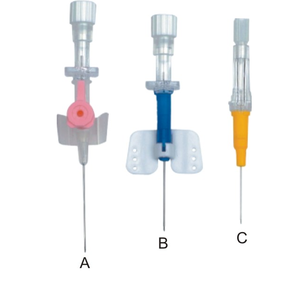
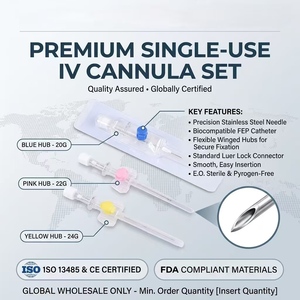
Good Price 14G 16G 18G 20G 22G 24G 26G Sizes Different Types IV Cannula and Color
- Full Gauge Range: 14G to 26G (ISO 6009 color coded)
- Radiopaque FEP / PUR catheter options
- Siliconized needle tip for low insertion force
MEDICA 2026 | 16–19 November 2026 | Hall 6, Stall F37 | Düsseldorf, Germany

Engineered with ISO 7864 and ISO 10555 standards, our sterile medical devices incorporate ultra-sharp tri-facet bevelled Japanese stainless steel and medical-grade biocompatible polymers for zero-trauma vascular access.
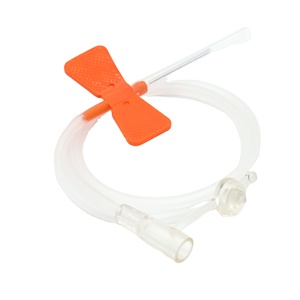
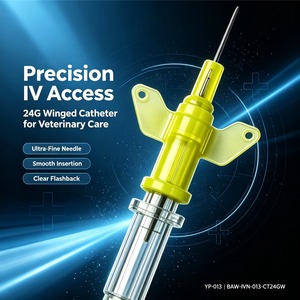
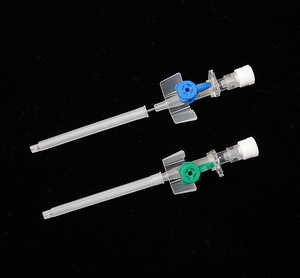
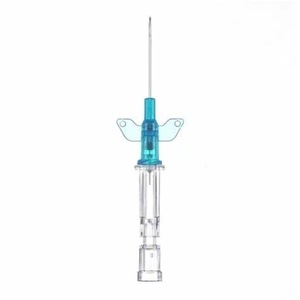
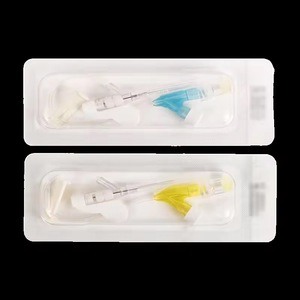
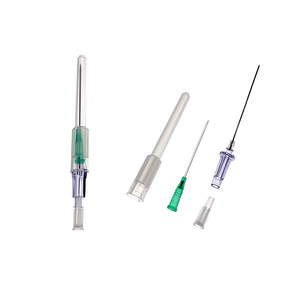
In global healthcare supply chains, selecting the right partner among China best hypodermic needle manufacturers & factory options requires rigorous technical evaluation. Hypodermic needles and peripheral intravenous (IV) cannulas represent high-volume, critical-touch medical disposables. Clinical outcomes, infection control protocols, and patient comfort directly depend on micro-engineering precision: bevel geometry, needle siliconization, hub concentricity, and catheter biocompatibility.
Leading Chinese manufacturing hubs have undergone a technological revolution. Transitioning from basic manual assembly lines to fully automated, ISO Class 8 cleanroom injection molding, laser-guided needle grinding, and robotic packaging, top-tier factories now compete directly with European legacy brands. They deliver equivalent compliance under EU MDR 2017/745, US FDA 510(k), and global ISO standards, while maintaining significant cost efficiency for hospital procurement departments and global medical distributors.
A premier hypodermic needle factory operates under strict quality management systems (QMS) governed by ISO 13485:2016. The anatomy of a high-performance disposable medical needle involves four key technical components:
Own mold design shop enabling custom gauge variations, color-coding matching ISO 6009, and rapid prototype development for private-label clients.
Complete regulatory dossier kits supplied with each consignment: CE Certificate, EC Declaration of Conformity, Free Sale Certificate, and batch-wise CoA.
Fully automated particulate-monitored environments preventing microbial contamination, bioburden risk, and pyrogen exposure prior to EO sterilization.
As a premier OEM exporter, Chinese factories provide bespoke production solutions tailored to national healthcare tenders, hospital networks, and private-label medical device brands across 100+ countries.
| Manufacturing Parameter | Standard Specification Range | OEM Customization Options | Quality Assurance Protocol |
|---|---|---|---|
| Needle Gauge Sizes | 14G, 16G, 18G, 20G, 22G, 24G, 26G, 27G, 30G | Custom lengths (13mm to 50mm), Thin-Wall & UTW variants | Laser visual inspection for bevel burrs & gauge accuracy |
| Catheter Material | Fluorinated Ethylene Propylene (FEP), Polyurethane (PUR) | Radiopaque line stripes (3-line/4-line), DEHP-free PUR | ISO 10555-5 tensile strength & kinking resistance test |
| Safety Shield Mechanism | Active push-button clip, Passive auto-encapsulating shield | Custom safety mechanism integration for sharps safety laws | 100% activation pull-test verification |
| Packaging Configurations | Hard blister pack, Soft pouch pack, Polybag bulk | Multilingual IFU printing, UDI Barcoding, Private Label Box | ISO 11607 seal integrity & dye penetration testing |
| Sterilization Method | Ethylene Oxide (EO) Gas Sterilization | Gamma Ray / E-Beam irradiation compatible materials | ISO 11135 validation, Biological indicator incubation |
The global single-use medical device landscape is undergoing rapid structural transformations driven by safety legislation, environmental regulations, and clinical efficiency demands. Procurement heads and B2B buyers must align their supply strategies with these four key emerging industry trends:
Driven by the EU Directive 2010/32/EU and the US Needlestick Safety and Prevention Act, global healthcare systems are mandating passive safety IV cannulas. Needlestick injuries (NSIs) pose severe occupational risks for blood-borne pathogen transmission (HIV, HBV, HCV). Next-generation safety hypodermic needles feature automated passive clips that lock over the sharp tip instantly upon withdrawal without requiring additional clinical steps.
Environmental health initiatives are pushing manufacturers away from traditional Di(2-ethylhexyl)phthalate (DEHP) plasticized PVC tubing. Medical disposables are adopting advanced Polyurethane (PUR) and TOTM-plasticized materials. PUR catheters soften inside the vein at body temperature, minimizing phlebitis, catheter-related bloodstream infections (CRBSI), and mechanical vascular irritation.
Traditional venipuncture often results in blood leakage during hub attachment, leading to contamination risks and extended clean-up times. Modern BCT IV cannulas incorporate a septum inside the catheter hub that automatically seals blood flow until the luer lock line is connected. Closed-loop IV access reduces blood exposure to zero, safeguarding healthcare workers in emergency departments.
Pediatric, neonatal, and oncology patients require micro-gauge needles (24G, 26G, 30G) to preserve fragile veins. By utilizing Ultra-Thin-Wall cannula drawing techniques, manufacturers increase inner diameter lumens while keeping outer diameters tiny. This enables high-velocity fluid flow without causing mechanical shear stress on red blood cells during blood transfusions.
The competitive edge of China’s leading medical needle factories stems from continuous investment in automation, high-speed vision systems, and sustainable production technologies. Modern facilities operate integrated production steps that eliminate manual handling, reducing bioburden to historical lows.
High-speed assembly lines operate at speeds exceeding 600 units per minute. To maintain zero-defect standards, factories integrate 360-degree multi-camera optical inspection systems. These AI-driven cameras inspect 100% of production in real time for micro-burrs, needle point dullness, hub flash, silicone oil pooling, and missing components, automatically ejecting non-conforming units.
Beyond mechanical grinding, leading factories employ electrochemical deburring and ultrasonic multi-stage washing lines. This process removes microscopic stainless steel particles and oil residues from inner walls, ensuring smooth fluid contact surfaces compliant with ISO 9626.
While Ethylene Oxide (EO) gas remains the industry standard, progressive Chinese manufacturers are expanding Electron-Beam (E-Beam) sterilization options. E-Beam sterilization reduces processing turnaround times from days to hours, eliminates toxic gas residues completely, and minimizes structural polymer degradation in plastic hubs.
Essential technical, regulatory, and commercial answers for hospital procurement officers, tender bidders, and medical distributors.
For smooth customs clearance and regulatory approval, suppliers must provide an ISO 13485:2016 certified Quality Management System, CE Certification under EU MDR 2017/745 (for European markets), US FDA 510(k) clearance (for American markets), an EC Declaration of Conformity, a Certificate of Free Sale (CFS), and batch-wise Certificates of Analysis (CoA) documenting sterility, pyrogenicity, and non-toxicity.
Penetration force is evaluated according to ISO 7864 Annex d standards using standardized polyurethane foil or synthetic skin membranes. A force sensor measures the peak penetration value (N) as the needle pierces the substrate. Premier factories engineer needles to achieve peak penetration force below 0.3 Newtons, ensuring minimal patient pain.
FEP (Fluorinated Ethylene Propylene) offers high structural firmness, excellent chemical stability, and cost-efficiency, making it ideal for short-term venous access. PUR (Polyurethane) is a premium biocompatible polymer that softens inside the blood vessel at body temperature. PUR conforms to vein contours, reducing mechanical phlebitis, catheter kinking, and vascular trauma during indwelling therapy exceeding 48 hours.
For neutral factory packaging, MOQs start at 10,000 units per gauge size. For custom OEM private label packaging (custom blister foil, inner box, and outer carton printing), MOQs typically range from 100,000 to 300,000 units per SKU depending on printing plate setup. Production lead times average 3 to 4 weeks for repeat catalogue orders and 5 to 6 weeks for initial OEM orders requiring artwork proofing and sterilization validation.
Safety IV cannulas incorporate a passive or active stainless steel safety clip mechanism located inside the catheter hub. As the clinician withdraws the metal stylet, the clip automatically snaps over the sharp needle tip, permanently locking it inside a protective housing. This prevents accidental needle exposure, protecting healthcare personnel from blood-borne cross-contamination.
Medical needles are sterilized using Ethylene Oxide (EO) gas in accordance with ISO 11135. Each sterilization chamber cycle utilizes biological indicators (Bacillus atrophaeus) and chemical indicators inside every carton. Sterility Assurance Level (SAL) is validated to 10-6. EO residue levels are aerated down to compliant thresholds below 4 mg/device per ISO 10993-7.
Yes, evaluation samples accompanied by technical data sheets (TDS), sterilisation certificates, and material safety data sheets (MSDS) are dispatched via international express (DHL/FedEx) for hospital nursing staff and QA teams to verify insertion force, hub fitment, and packaging seal integrity prior to contract execution.