
MEDICA 2026 | 16–19 November 2026 | Hall 6, Stall F37 | Düsseldorf, Germany
Choosing reliable Blood Transfusion Set suppliers requires more than comparing prices or polished catalogs. Global buyers must examine product quality, manufacturing experience, regulatory documentation, and after-sales support. A dependable supplier should provide clear specifications for tubing length, needle options, filter design, packaging, and sterility status. Small details matter. A damaged seal or unclear label can disrupt hospital workflows and raise safety concerns.
This guide introduces leading Blood Transfusion Set suppliers serving international buyers. It considers manufacturing capacity, quality management systems, export experience, customization services, and communication reliability. Buyers should look for evidence such as batch records, inspection reports, traceability procedures, and consistent responses to technical questions. Certifications can support trust, but they should be verified against current product information and the destination market’s requirements.
No supplier ranking is perfect. Procurement conditions differ between hospitals, distributors, and emergency-care networks. Some buyers may value high-volume production, while others need flexible packaging or private-label support. Delivery performance can also change with materials, shipping routes, and regional demand. Therefore, this overview should support careful evaluation rather than replace professional purchasing review. Ask precise questions. Request samples when appropriate. Confirm every important claim. A supplier may appear impressive online, yet practical reliability is measured through documentation, product consistency, and real communication over time.
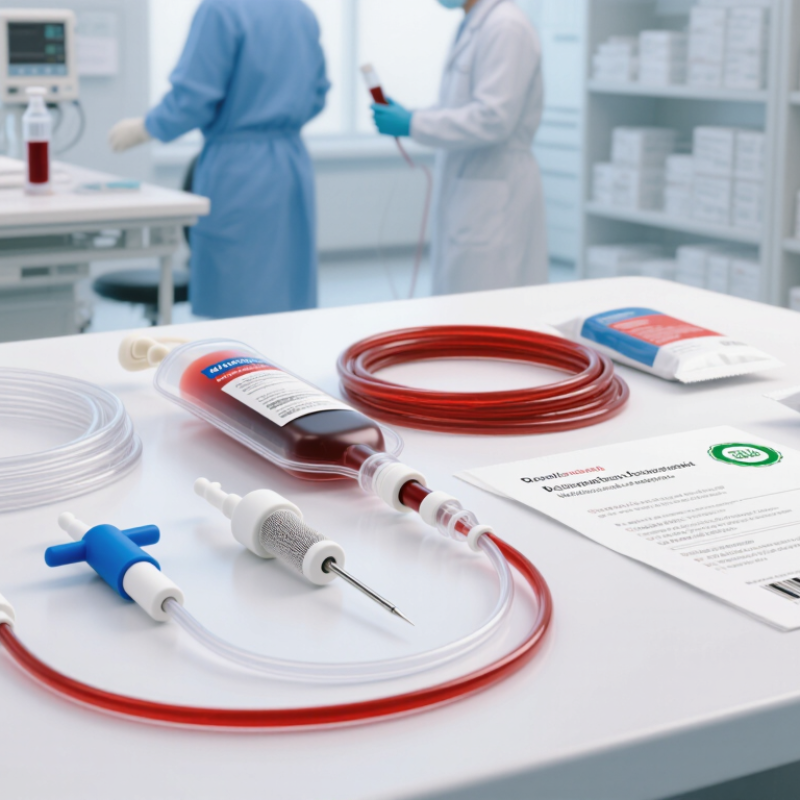
A blood transfusion set is a sterile, single-use medical device for delivering blood or blood components into a patient’s bloodstream. It usually includes a piercing spike, drip chamber, flexible tubing, flow clamp, and patient connector. Many designs also contain an in-line filter, commonly intended to reduce the passage of small clots or particles. The filter’s specification matters, because blood products and clinical procedures may differ.
During use, trained healthcare professionals connect the set to a compatible blood container and vascular access device. They check the package seal, expiry date, tubing condition, and connection security before starting the transfusion. Air removal, flow control, and patient observation require careful attention. A set may look simple, but small details can affect handling. Even experienced buyers can focus too heavily on price and overlook filter design, priming volume, or connector compatibility. That is an easy mistake.
Tips: Confirm the intended blood product and required filter before purchasing. Check sterile packaging and traceability documents. Review tubing length, clamp performance, and connector type against clinical needs. Ask suppliers for clear product specifications and quality certificates. Do not assume every transfusion set suits every procedure. Procurement teams should also evaluate storage conditions and delivery reliability, especially for international orders. Shorter tubing is not always better. Practical testing can reveal handling problems that a catalogue cannot.
For global buyers, a blood transfusion set supplier should explain every component clearly. A typical set includes a piercing spike, drip chamber, blood filter, flexible tubing, roller clamp, injection port, and patient connector. Each part supports safe and controlled transfusion. The filter should retain visible particles without slowing flow excessively. The tubing needs consistent inner diameter and kink resistance. Small defects can create serious handling problems.
Functional requirements deserve practical testing. Check sterility records, biocompatibility evidence, leakage results, particle-control data, and packaging integrity. The protective caps should remain secure during transport. Connectors must fit compatible equipment without force or looseness. Clear markings help nurses identify the clamp and flow direction quickly. Suppliers should provide batch traceability, inspection procedures, and realistic shelf-life data. In my experience, samples often look perfect. Production consistency is harder.
Tips: Request samples from different production batches. Test them with actual blood bags and pumps when applicable. Inspect the filter, clamp, ports, and seals under bright light. Ask how rejected units are recorded. Do not rely only on a certificate. Confirm shipping conditions, documentation, and response times before placing large orders. One overlooked detail: packaging may protect sterility but still waste storage space. It is worth reviewing with clinical and logistics teams.
| Evaluation Category | Essential Component or Supplier Data | ||
|---|---|---|---|
| Product Classification | Blood transfusion administration set | A sterile, single-use device designed to transfer blood or blood components from a container to a patient. The product configuration should match the intended use, such as whole blood, red blood cells, plasma, or platelets. | Confirm the intended clinical use, device classification in the destination market, single-use labeling, and compatibility with the blood-container connection system. |
| Applicable Standard | Blood administration-set standard | The design and performance documentation should address ISO 1135-4 or the current equivalent adopted by the target market for single-use transfusion equipment. | Request the applicable standard list, test reports, declaration of conformity, and documentation showing that the tested configuration matches the supplied product. |
| Fluid Path | Tubing and connectors | The fluid path should be smooth, securely bonded, free from visible particles, and designed to minimize leakage, air entry, kinking, and accidental disconnection. Patient-end connectors should be compatible with the intended access device. | Review connector drawings, leakage and tensile-strength results, dimensional tolerances, and samples from routine production. |
| Blood Filter | Integrated transfusion filter | A standard blood administration set commonly uses a filter in the approximate 170–260 micrometre range to retain clots, aggregates, and particulate matter. The exact pore size and filter area should be stated in the technical specification. | Check filter-material information, pore-size verification, flow-performance data, filter integrity, and suitability for the specified blood component. |
| Drip Chamber | Transparent drip chamber | The chamber should allow visual monitoring of drops and air, provide reliable venting where required, and support controlled priming without excessive foaming. | Inspect chamber visibility, drip-factor specification, vent design, priming instructions, and performance under the stated operating conditions. |
| Flow Control | Roller clamp or flow regulator | The clamp should provide repeatable flow adjustment, remain secure during use, and avoid damaging the tubing. The set should be compatible with a pump if it is marketed for pump-assisted transfusion. | Request flow-control testing, tubing-occlusion data, pump-compatibility information, and validation for the stated tubing dimensions. |
| Air Management | Vented or non-vented configuration | Vented sets require an appropriate hydrophobic air filter and controlled air passage. Non-vented sets should be clearly identified for use with collapsible blood bags or systems that do not require container venting. | Confirm the vent type, air-filter rating, intended container type, air-leak performance, and packaging label instructions. |
| Materials | Medical-grade polymers | Tubing and components should use materials suitable for blood contact and sterilization. If plasticized PVC is used, the plasticizer type and regulatory status should be disclosed; alternatives may be required for specific markets or institutional policies. | Obtain material declarations, chemical-composition information, extractables and leachables data where applicable, and a statement on substances restricted by the destination market. |
| Biocompatibility | Blood-contacting materials | The finished device should undergo a risk-based biological evaluation appropriate for externally communicating, blood-contacting devices, including assessment of cytotoxicity, sensitization, irritation, and other applicable endpoints. | Review the biological evaluation report, test reports, material-change controls, and conformity with the applicable biological-evaluation framework, such as ISO 10993. |
| Sterilization | Sterile barrier and sterilization method | Common sterilization methods include ethylene oxide or radiation, depending on the product materials and validated process. The process must achieve the required sterility assurance level without compromising device performance. | Request sterilization validation, residuals or dose records, aeration information where relevant, and evidence of routine process monitoring. |
| Packaging | Primary and secondary packaging | Packaging should protect the sterile barrier from damage during transport and storage. Seal integrity, material compatibility, and shelf-life claims should be validated for the labeled storage conditions. | Check packaging-validation reports, seal-strength and integrity testing, transport simulation, storage-temperature limits, and packaging specifications. |
| Shelf Life | Stability and expiry period | The expiry date should be supported by real-time or accelerated stability data covering sterility, packaging integrity, tubing flexibility, connector security, filter performance, and label legibility. | Confirm the validated shelf life, lot traceability, expiry-date format, storage conditions, and ongoing stability-monitoring program. |
| Functional Performance | Flow rate and priming volume | Flow performance depends on tubing dimensions, filter design, fluid viscosity, temperature, hydrostatic pressure, and use of a pump. Priming volume should be declared rather than assumed. | Compare laboratory flow data with the buyer's clinical protocol, pressure limits, warming equipment, and pump requirements. Request representative samples for testing. |
| Safety Features | Needle-free or luer-access options | Optional access components should reduce needle-stick risk and maintain secure, leak-resistant connections. Any needle or access device included in the set should have clearly specified dimensions and protective features. | Evaluate connection security, leakage, disconnection force, activation cycles where applicable, and compatibility with existing hospital connectors. |
| Labeling | Instructions and symbols | Labels should identify the product type, sterile status, single-use status, lot number, expiry date, storage conditions, sterilization method, and relevant warnings using recognized medical-device symbols. | Review multilingual artwork, symbols based on ISO 15223-1 where applicable, instructions for use, readability, and country-specific labeling requirements. |
| Quality System | Manufacturing controls | The supplier should operate a documented medical-device quality-management system, typically aligned with ISO 13485, covering design control, purchasing, production, process validation, nonconformity control, and corrective actions. | Request a current quality certificate, audit summary, scope of certification, inspection records, and evidence that critical processes are validated. |
| Regulatory Readiness | Market-access documentation | Regulatory evidence must correspond to the destination country or region. Documentation may include technical files, risk management, clinical or performance evidence, authorized-representative details, and post-market-surveillance procedures. | Confirm that certificates and registrations are current, product-specific, and valid for the exact manufacturing site and configuration being purchased. |
| Traceability | Lot control and recall capability | Each production lot should be traceable to raw materials, critical manufacturing records, sterilization records, inspection results, packaging, and distribution data. | Review sample certificates of analysis, lot-release criteria, complaint-handling procedures, recall procedures, and retention-sample policies. |
| Supply Capability | Capacity and lead time | A qualified supplier should demonstrate stable production capacity, documented change control, contingency planning, and lead times that support the buyer's forecast and emergency requirements. | Compare confirmed monthly capacity, minimum order quantity, standard lead time, replenishment plan, production-site location, and business-continuity arrangements. |
| Customization | Configuration and private labeling | Available options may include tubing length, filter specification, connector configuration, vent type, drip factor, clamp style, packaging format, and multilingual labeling. Changes must remain under formal design and regulatory control. | Request a configuration matrix, engineering-change procedure, sample approval process, tooling requirements, validation responsibility, and minimum order quantities. |
| Commercial Terms | Total landed cost | The purchasing comparison should include product price, packaging, sterilization, inspection, freight, insurance, import duties, regulatory fees, payment terms, and costs associated with rejected or damaged goods. | Use a documented quotation with Incoterms, currency, validity period, payment terms, warranty or complaint terms, delivery commitment, and quality-acceptance criteria. |
| Buyer Acceptance | Pre-shipment and incoming inspection | Acceptance criteria should cover product identity, dimensions, appearance, packaging integrity, sterility status, labeling, lot information, connector security, filter presence, and quantity. | Establish an approved sample, inspection level, defect classification, certificate requirements, nonconformance process, and release procedure before the first commercial shipment. |
Buyer note: Specifications such as filter size, flow rate, tubing dimensions, connector type, sterilization method, and shelf life can vary by product configuration and destination-market requirements. Final acceptance should be based on the supplier's validated technical file, applicable regulations, and the buyer's clinical protocol.
Top Blood Transfusion Set Suppliers for Global Buyers
Key Standards for Blood Transfusion Set Safety
Safety should guide every transfusion set purchase, not price alone. Experienced buyers check whether suppliers follow ISO 1135-4 and operate a documented quality system. ISO 13485 certification can support this review, but a certificate does not replace factory assessment. Ask for current audit records, production controls, and batch traceability. Small details matter.
Each set should have secure connectors, a reliable filter, clear tubing, and a leak-resistant drip chamber. Suppliers should verify flow performance, sterility, packaging integrity, and particulate control. Risk management under ISO 14971 helps identify failures before products reach hospitals. Biocompatibility evidence may also be relevant for patient-contact materials. Test reports should identify methods, sample numbers, and acceptance limits.
Global buyers need more than technical documents. They should inspect storage conditions, shipping protection, complaint handling, and recall procedures. A supplier’s response to a difficult question often reveals its real quality culture. Request samples from normal production, not specially prepared units. No checklist is perfect. Even experienced teams can overlook connector fit or damaged seals during visual inspection. Independent testing may be worthwhile when purchasing large volumes or entering a new market. Requirements also differ by destination, so regulatory review should involve qualified local professionals. Clear records make safety decisions more defensible.
The chart shows the publication year of internationally recognized standards commonly used when qualifying blood transfusion set suppliers. ISO 1135-4 directly addresses single-use transfusion sets, while ISO 10993-1, ISO 14971, and IEC 62366-1 support biological safety, risk management, and usability evaluation. Publication year indicates the current referenced edition, not a supplier performance score.
Top Blood Transfusion Set Suppliers for Global Buyers
Global buyers should evaluate suppliers through evidence, not attractive catalogs. The WHO Global Status Report on Blood Safety and Availability 2021 recorded 118.5 million blood donations worldwide. Nearly 40% came from high-income countries, which represented only 16% of the global population. This uneven supply environment makes dependable medical device sourcing essential.
Ask for ISO 13485 certification, recent audit findings, and product-specific validation records. Check whether each transfusion set meets ISO 1135-4 requirements for single-use containers and accessories. Review sterilization validation, bioburden controls, endotoxin testing, and shelf-life data. A supplier should also provide lot-level traceability, not just a generic certificate. Examine the label closely. It should show the lot number, expiry date, sterilization method, and storage conditions.
Test samples under realistic hospital conditions. Measure flow consistency, clamp performance, tubing flexibility, and connection security. Packaging should survive humid warehouses and long-distance transport. WHO guidance emphasizes safe blood handling across the entire supply chain, not only at the collection site. Ask for complaint rates and corrective-action records. Silence is not proof of quality. A polished audit file can still hide weak production discipline. Buyers should also compare capacity, backup manufacturing sites, lead times, and change-control procedures. I would request one small trial order before signing a large contract. That step costs time, but it may reveal packaging damage, unclear instructions, or inconsistent components.
Global buyers should compare blood transfusion set suppliers through quality, capacity, and service, not price alone. WHO’s Global Status Report on Blood Safety and Availability 2021 recorded about 118.5 million blood donations worldwide. This scale increases demand for consistent, traceable, single-use equipment.
Quality begins with compliance. Suppliers should provide evidence of ISO 13485 certification, validated sterilization, and conformity with ISO 1135-4 for transfusion sets. Buyers should inspect tubing clarity, drip-chamber accuracy, needle protection, connector security, and package sealing. Small details matter. Lot-level inspection reports and retained samples can reveal defects that certificates may miss. In practice, buyers sometimes overtrust paperwork. That is a weakness worth correcting.
Capacity requires more than a large factory. Ask for monthly output, production redundancy, raw-material sources, and recent on-time delivery data. A supplier with two qualified production lines may offer greater continuity than a larger but single-site manufacturer.
The WHO report also highlights uneven blood-service infrastructure across regions, so packaging, storage guidance, and shipping conditions need local review. Service should include technical files, complaint response targets, multilingual documentation, and support during audits. A practical test is simple: send the same technical question to several suppliers and compare response speed, evidence, and clarity. Slow answers can signal future delays. Pricing still matters, but dependable quality and documented capacity usually protect hospitals better than the lowest quotation.
It is a sterile, single-use device for delivering blood or blood components into a patient’s bloodstream. Trained healthcare professionals use it.
Common parts include a piercing spike, drip chamber, tubing, roller clamp, filter, injection port, and patient connector. Each part supports controlled delivery.
The filter helps retain small clots or visible particles. Its specification should match the blood product and clinical procedure.
Confirm the intended blood product, filter requirements, connector type, tubing length, and clamp performance. Do not assume one design fits every procedure.
Inspect the package seal, protective caps, expiry date, and traceability documents. Check for damaged packaging or unclear batch information.
Different batches can reveal variation in seals, filters, tubing, and clamps. A perfect sample proves little. Production consistency matters more.
Test connectors with compatible blood containers, vascular access devices, and pumps when appropriate. Connections should fit securely without force or looseness.
Inspect units under bright light for leaks, kinks, loose caps, and filter defects. Review sterility records, particle-control data, and leakage results.
Review storage conditions, shelf life, shipping protection, delivery reliability, and packaging size. Sterile packaging can still consume excessive warehouse space.
Choosing mainly by price can hide problems with filters, priming volume, or connector compatibility. A catalogue cannot reveal every handling problem.
A Blood Transfusion Set is a sterile, single-use medical device designed to deliver blood or blood components safely from a container to a patient. Its essential components typically include a piercing spike, drip chamber, fluid pathway, filter, tubing, roller clamp, connector, and protective caps. Each part must support reliable flow control, minimize contamination risks, and maintain compatibility with standard blood bags and infusion equipment. Safety depends on consistent manufacturing, effective sterilization, biocompatible materials, leak resistance, and compliance with applicable medical-device standards and quality-management requirements.
For global buyers, evaluating suppliers should involve more than comparing prices. Buyers should review product specifications, certifications, quality-control procedures, production capacity, traceability systems, packaging, lead times, and after-sales support. A practical supplier comparison should consider quality consistency, ability to fulfill large or recurring orders, customization options, communication efficiency, documentation, and delivery reliability. Selecting a supplier that demonstrates strong technical capability, transparent processes, and dependable service can help healthcare organizations obtain safe, consistent, and fit-for-purpose transfusion products.